NEW JOURNEY


Begin with the work your team will perform
An individual battery cell is a component for pack development. A finished battery pack is an assembly with a defined cell configuration and mechanical and electrical interfaces. Buying a finished pack reduces the assembly work still to be specified, but it does not remove the need to confirm compatibility with the equipment.
The right choice depends on who will design the interconnections, insulation, retention, protection arrangement and charging interface. If your team owns those tasks and the associated verification, cells may be the appropriate purchasing route. If you need an assembly to evaluate in an aircraft, start with a finished pack and define its installation requirements.
Different supply scopes require different checks
| Decision | Individual cells | Finished packs |
|---|---|---|
| Electrical starting point | Cell voltage, capacity and cell-level operating limits | Pack configuration, voltage range and qualified assembly limits |
| Mechanical review | Cell dimensions, tabs, allowable handling and support | Body dimensions, wrapping or enclosure, leads, mounting and access |
| Connections | Tab joining and pack interconnection design remain to be specified | Confirm the supplied power and balance connections, polarity and mating parts |
| Protection and charging | Define the protection, balancing and charging approach for the assembly | Confirm what is included and what the host equipment or charger must provide |
| Mass comparison | A cell mass applies to the individual cell | Finished mass includes the assembly components specified for that pack |
| Documentation | Request the cell specification and applicable model records | Request the pack drawing, configuration and records for the supplied assembly |
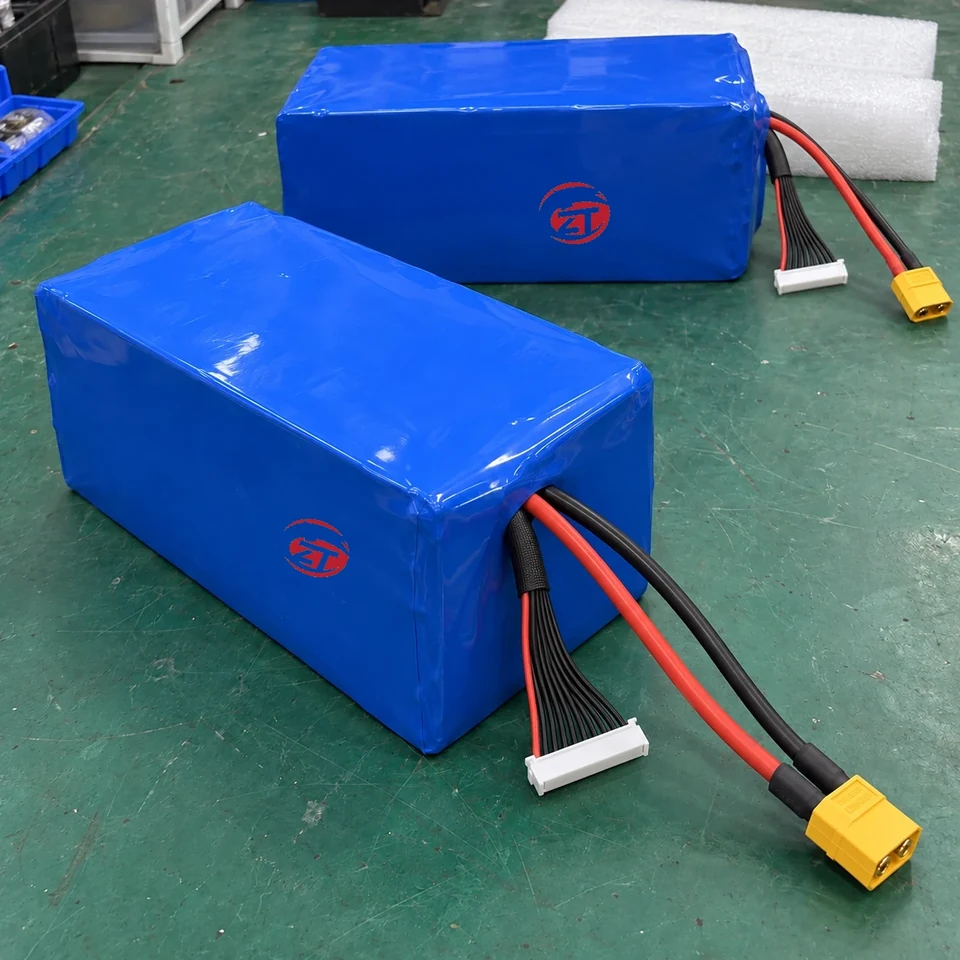
A finished UAV pack must not be assumed to contain an internal BMS or a rigid enclosure. Read the specific product description. For example, the 12S model linked below specifies PVC wrapping and power and balance interfaces; those details do not establish that an internal protection system is included. Agree the protection and monitoring arrangement explicitly.
Cell examples for pack developers
The 3.8V 16000mAh 25C LiPo Cell is specified as a pouch cell with a nominal voltage of 3.8V and a rated capacity of 16Ah. Its normal charge ceiling is 4.35V. These are cell-level values, not the voltage or approved current limit of a finished multi-cell assembly.
The 3.6V 67Ah Solid State Battery Cell is also a pouch cell, with a nominal voltage of 3.60V and a rated capacity of 67Ah. Its specification includes cell dimensions, tabs and operating limits. It belongs in a cell-selection discussion, not in a list of ready-to-install UAV packs.
The solid-state designation does not guarantee longer flight time. It does not establish that this cell is used in any particular finished pack linked on this page. For a wider component shortlist, explore Battery Cells and Battery Cells for Pack Integration.
Already have a pack design? Send your cell and assembly requirements, including the intended configuration, joining approach, installation constraints and the work your team will carry out.
Finished pack examples for integration teams
The 12S 16000mAh 25C UAV Battery lists a 12S1P configuration, 44.4V nominal voltage and 16Ah rated capacity. Its published nominal energy is 710.4Wh, calculated from nominal voltage and rated capacity. This illustrates a complete pack specification; it must not be represented as an assembly of the 3.8V cell above simply because both have a 16Ah capacity.
The 6S 40000mAh Semi-Solid UAV Battery separately identifies a 6S1P assembly with 22.2V nominal voltage and 40Ah rated capacity. Its product page records the pack body, reference mass and power and balance connections. Keep this semi-solid model designation separate from the solid-state cell example; the technology name itself does not guarantee longer flight time.
For further options, use UAV and Drone Batteries. The Solid-State UAV Batteries hub includes relevant cell and pack entries with model-specific designations. The technology comparison guide explains how to keep those descriptions separate.
Compare energy and mass at the same level
Cell Wh/kg is not finished-pack Wh/kg. Pack integration adds components such as interconnections, insulation, wrapping, leads and any specified enclosure or protection hardware. A cell-level energy-density figure cannot be carried unchanged into a finished-pack claim.
Use the actual assembly specification when evaluating installed mass. Capacity alone also cannot establish equivalence: the cell examples and pack examples here operate at different voltages and have different integration responsibilities. Do not use a shared capacity number as evidence of a shared construction.
Choose the next action for your project
For an established pack-development programme, review the cell specifications and identify the assembly requirements your team will own. For an aircraft integration project, use the pack selection checklist and request the drawing and interface details of a finished model.
If you need help defining the supply scope, read Custom OEM battery packs and discuss your application with New Journey. State whether you need cells, a finished pack or a configuration discussion so the enquiry starts at the right level.