
Language
6S 22000mAh UAV Battery
New Journey's 6S 22000mAh UAV battery pairs a 22.5V nominal supply with 495Wh of nominal energy. This configuration is aimed at industrial multirotors whose takeoff and climb loads call for more current than the 30Ah energy-focused option. Its charging cut-off voltage is 26.1V, so charger and ESC limits deserve attention before a replacement is selected.
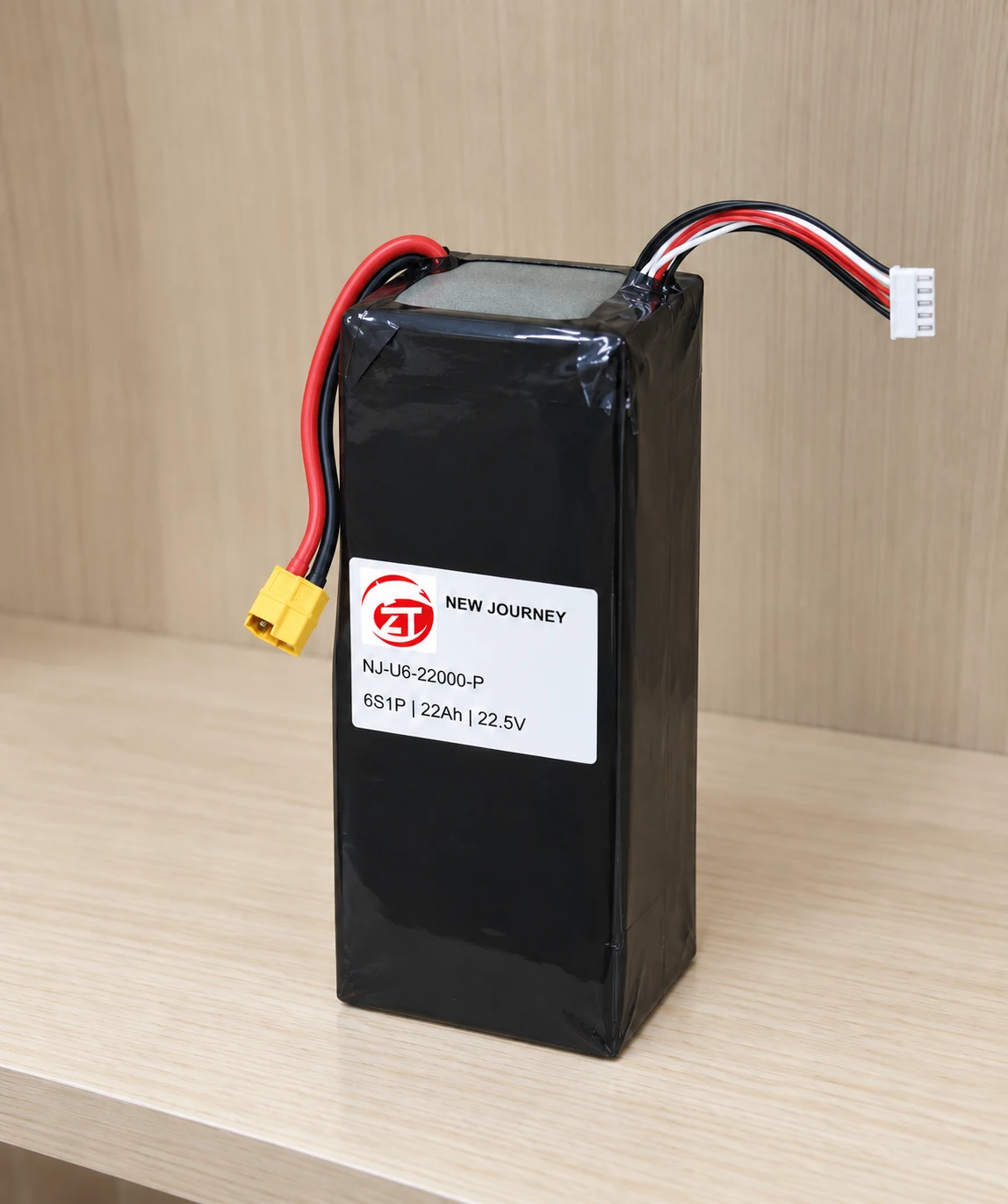
- 22.5VNominal voltage
- 495WhNominal energy
- 26.1VCharging cut-off
- 110AContinuous design target
Technical specifications
| Configuration | 6S1P · 22Ah (22000mAh) |
|---|---|
| Nominal voltage | 22.5V |
| Nominal energy | 495Wh · calculated from nominal voltage × rated capacity |
| Charging cut-off voltage | 26.1V · 4.35V per cell |
| Standard charge current (design) | 11A · 0.5C |
| Continuous discharge design target | 110A · 5C |
| Burst discharge design target | 220A · 10C for 10 seconds |
| Body dimensions L × W × T (design) | 218 × 96 × 70mm · ±5mm per axis; free leads and housings excluded |
| Calculated finished-pack weight | 2,670g · production tolerance ±10g from the approved nominal configuration |
| Calculated pack specific energy | 185.4Wh/kg · nominal energy ÷ calculated complete-pack mass |
| Calculated clearance thickness | 77mm · cell growth allowance, separate from initial body tolerance |
| Lead arrangement | About 150mm to connector entry; power and sensing at opposite sides of the same short face |
| Balancing interface | Seven contacts · B0 to B6 |
| Cell model | FAP10790192-22Ah |
| Main connector | Select the complete mating pair, lead specification and polarity for the aircraft |
Choosing between takeoff current and flight energy
A battery chosen for cruise alone can leave too little current margin at loaded takeoff. This 6S 22Ah configuration targets 110A continuously, compared with 60A for the 6S 30Ah option. The trade-off is 495Wh rather than 630Wh of nominal energy. Use the loaded takeoff and climb current to choose the current class, then check the energy required for the route and landing reserve.
Charging voltage and charger matching
Keeping an existing charging station can simplify a fleet purchase, but first check its charging voltage. This configuration has a 26.1V charging cut-off and an 11A standard-charge design setting. A fixed 25.2V programme has a different endpoint. Check adjustable voltage, the cell charging profile and six-group balancing before deciding which charger and adapter to retain.
Continuous and burst discharge current
The important purchasing question is how long a high load lasts. Continuous discharge current has a 110A design target; the 220A burst target applies for 10 seconds. Record the duration and spacing of loaded takeoffs, climbs and recovery peaks. Those conditions help New Journey specify the main lead and mating connector for the aircraft, rather than selecting a plug by appearance alone.
Pack weight and aircraft mass budget
Available payload is what remains after the battery, mounting tray and restraints are included. The calculated pack weight is 2,670g with its specified leads and connectors. At 495Wh, calculated pack specific energy is 185.4Wh/kg. Use this complete-pack mass in the aircraft budget; the cell energy-density figure has a different mass boundary. Longer cables or a different connector change the pack weight as well.
Battery dimensions and installation clearance
A pack can fit the tray yet still be difficult to secure or remove. The 218 × 96 × 70mm body has power and sensing leads leaving opposite sides of one short face. Check cover clearance, strap contact and room to reach both plugs. Provide a battery-bay drawing so the lead direction and bend space can be matched to the installation.

Series and parallel configuration
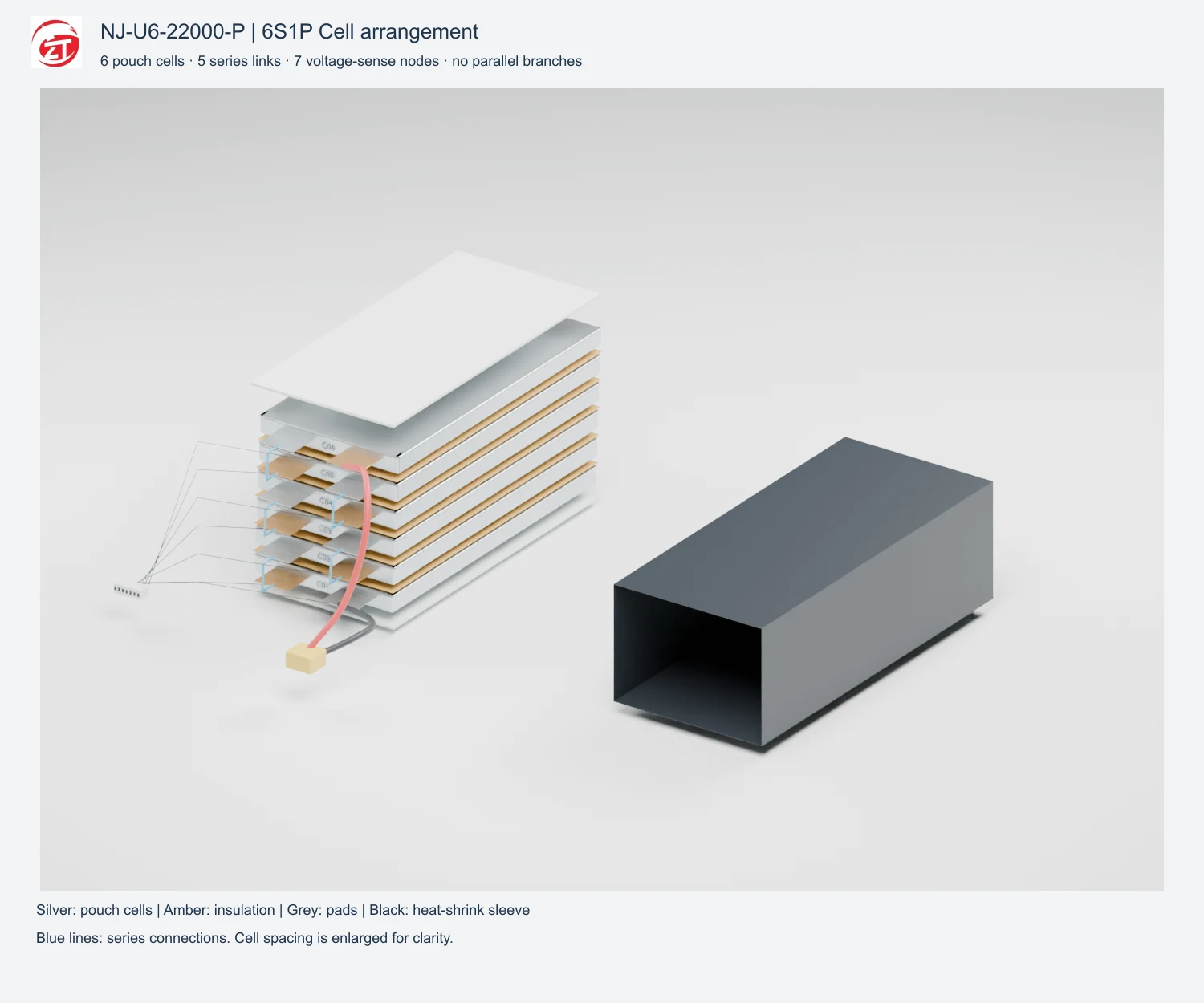
Replacement packs must match the charging harness as well as the main power plug. This 6S1P configuration uses six 22Ah pouch cells with seven sensing nodes, B0 to B6. Check the seven-contact connector and node order against the charger adapter. The sensing wires provide cell-group voltage access and balancing; the main lead carries the high-current load.
Frequently asked questions
Can I replace another 6S 22Ah drone battery with this one?
Compare the full voltage range first, including the 26.1V upper endpoint. Then check loaded current, body fit, weight, connector polarity and balancing pinout. Equal series count and capacity are only the starting point.
Would the 30Ah version be a better choice for longer flights?
It offers more nominal energy, but its 60A continuous design target is lower. Choose between them using both the aircraft load and its energy budget; a flight-time gain cannot be promised from capacity alone.
What should I send with a sample enquiry?
The ESC and charger models, a current trace, battery-bay drawing, mating connector part number, polarity and required quantity. Note the time spent at peak current and the clearance available at the cable exit.
Battery pack assembly
For loaded takeoffs, consistent cell selection and a well-supported current path matter alongside the current specification. New Journey can adapt the power leads, connector and short-end cable exits to the aircraft. Keep the balancing connector accessible so routine charging does not require removing the complete mount.



Discuss your aircraft configuration
Send your loaded takeoff current, charger model, battery-bay drawing and required quantity to New Journey. We can help select the lead direction and connector arrangement for your 6S 22Ah sample.