
Language
8S 22000mAh UAV Battery
This 8S 22000mAh UAV battery configuration brings the 22Ah cell platform to a 30V nominal bus, with 660Wh of nominal energy. It keeps the same 110A continuous design target as the 6S version while adding voltage and energy. The body is deeper, and the 34.8V charging cut-off must fit the aircraft's electronics.
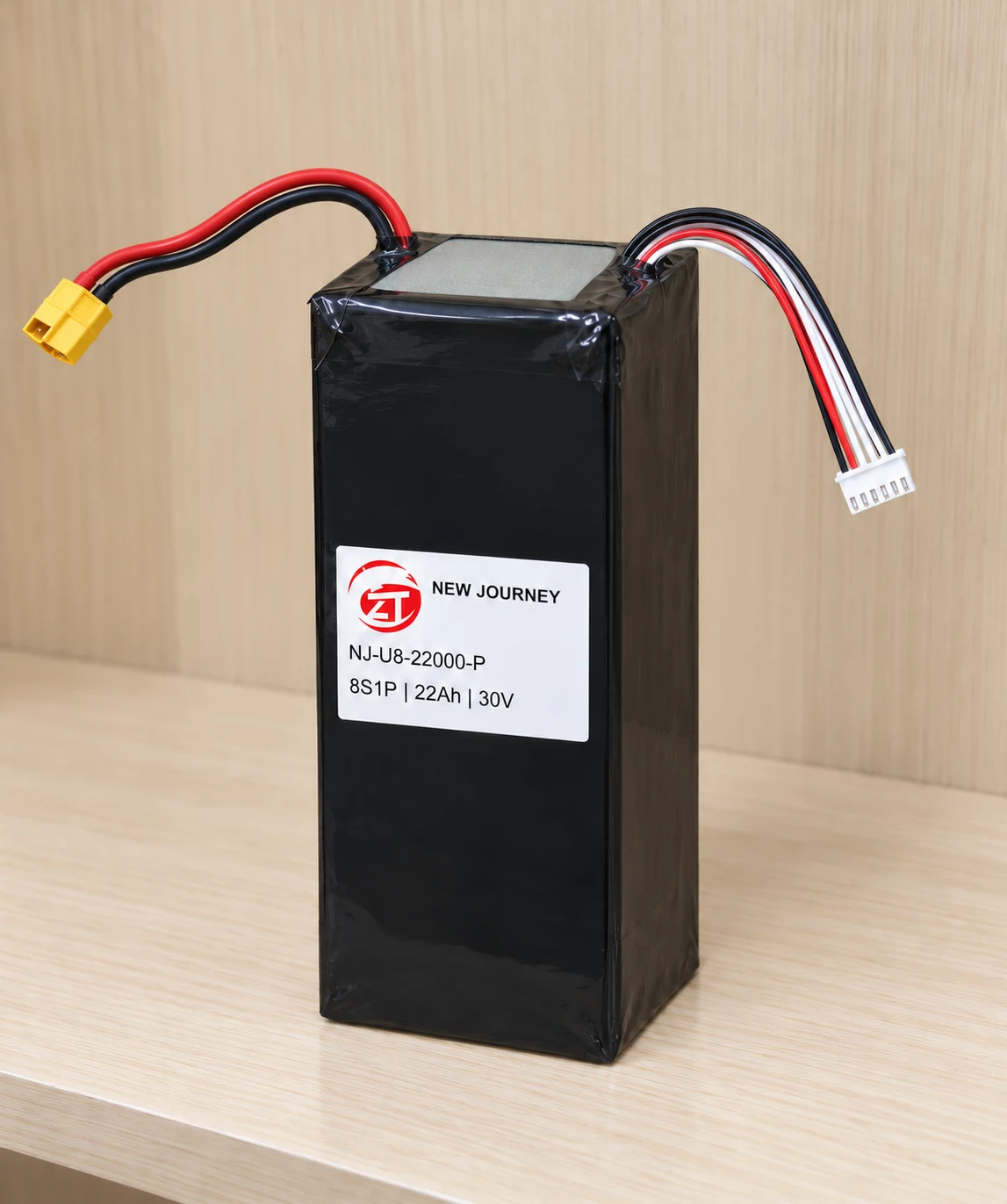
- 30VNominal voltage
- 660WhNominal energy
- 34.8VCharging cut-off
- 110AContinuous design target
Technical specifications
| Configuration | 8S1P · 22Ah (22000mAh) |
|---|---|
| Nominal voltage | 30V |
| Nominal energy | 660Wh · calculated from nominal voltage × rated capacity |
| Charging cut-off voltage | 34.8V · 4.35V per cell |
| Standard charge current (design) | 11A · 0.5C |
| Continuous discharge design target | 110A · 5C |
| Burst discharge design target | 220A · 10C for 10 seconds |
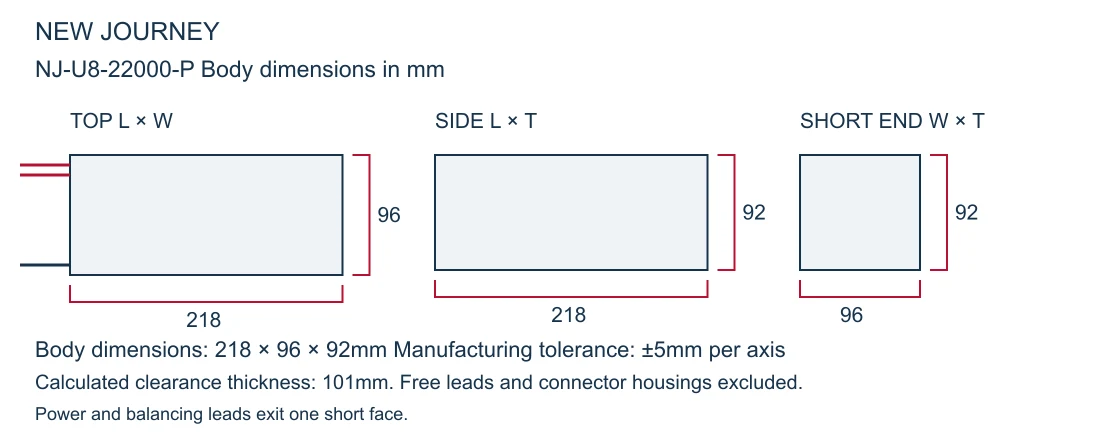
| Body dimensions L × W × T (design) | 218 × 96 × 92mm · ±5mm per axis; free leads and housings excluded |
| Calculated finished-pack weight | 3,500g · production tolerance ±10g from the approved nominal configuration |
| Calculated pack specific energy | 188.6Wh/kg · nominal energy ÷ calculated complete-pack mass |
| Calculated clearance thickness | 101mm · cell growth allowance, separate from initial body tolerance |
| Lead arrangement | About 150mm to connector entry; power and sensing at opposite sides of the same short face |
| Balancing interface | Nine contacts · B0 to B8 |
| Cell model | FAP10790192-22Ah |
| Main connector | Select the complete mating pair, lead specification and polarity for the aircraft |
More energy on 8S without overlooking the aircraft conversion
Moving to 8S can add energy while keeping 22Ah capacity, but it also changes the supply seen by the ESCs and auxiliary converters. This version carries 660Wh instead of the 6S model's 495Wh, with the same 110A continuous-current design target. Choose it for an eight-series aircraft architecture; changing the battery alone does not convert an unchanged 6S power system.
Charging voltage and charger matching
Before buying batteries for an existing charging station, check whether it supports a 34.8V charging cut-off. Some 8S programmes end at 33.6V. This configuration uses an 11A standard-charge design setting and eight-group balancing. Confirm the voltage adjustment, cell profile and nine-node adapter together so that the charger and battery harness are ordered as a working combination.
Continuous and burst discharge current
An eight-series label does not mean more current capability than the 6S version. The design targets remain 110A continuous discharge current and 220A for a 10-second burst. If the aircraft uses higher voltage to change its motor and propeller setup, obtain the new load trace. Use that trace to specify conductors, connectors and repeated peak duty for the complete installation.
Pack weight and aircraft mass budget
The extra energy comes with an aircraft-weight cost. Calculated pack weight is 3,500g: 830g more than the 6S 22Ah option for an additional 165Wh. Check whether the airframe can carry that increase while preserving its payload requirement. Calculated pack specific energy is 188.6Wh/kg; include tray and restraint mass separately when comparing installed battery systems.
Battery dimensions and installation clearance
Reusing a 6S tray requires more than checking length and width. The 8S body measures 218 × 96 × 92mm, adding 22mm of thickness. Check the cover, strap adjustment and access around the short-end cable exits. Each lead is approximately 150mm to connector entry; allow additional space for the connector housing, cable bends and disconnection.
Series and parallel configuration
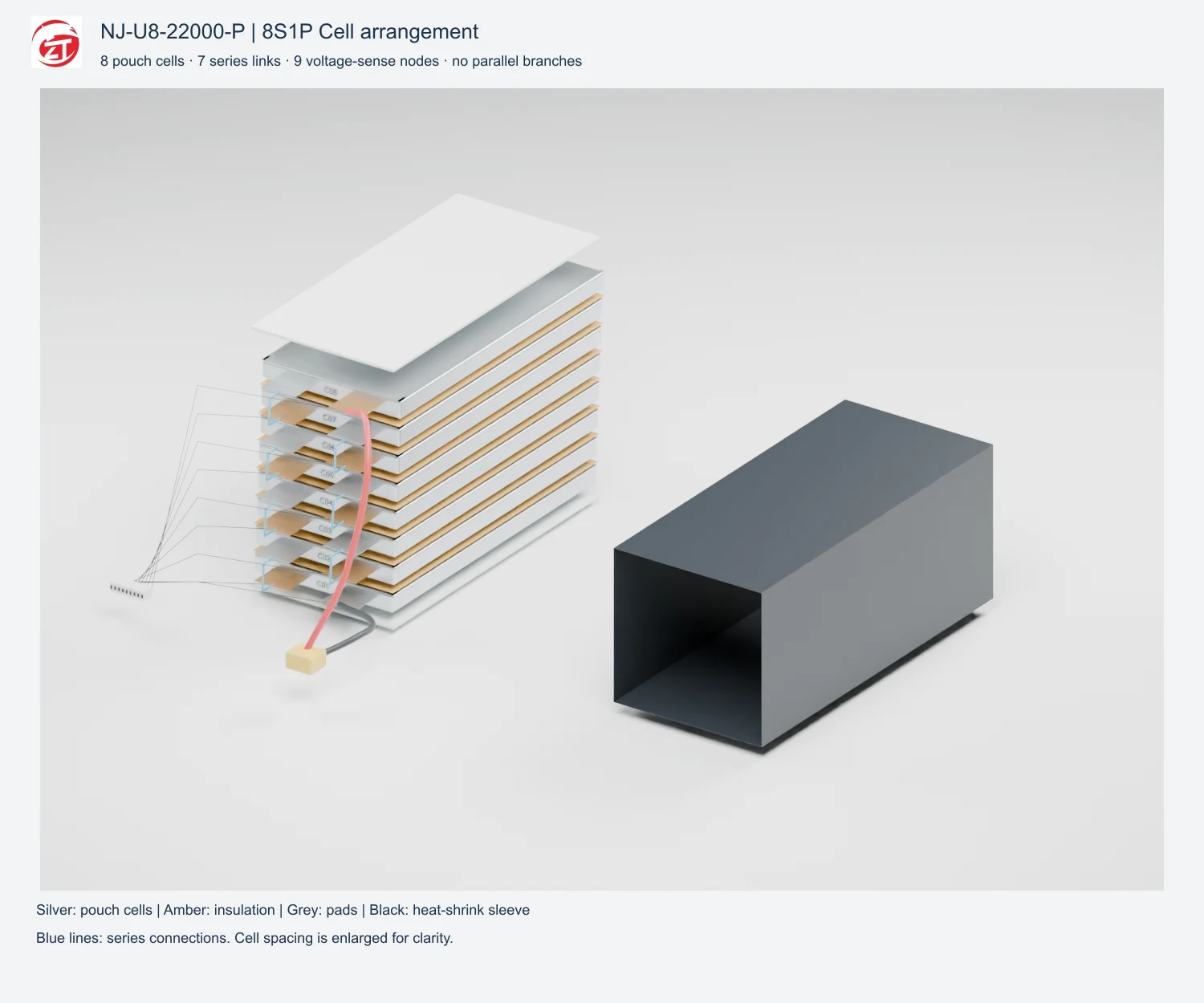
Ordering by connector shape can lead to an incompatible balancing harness. The 8S1P layout has eight 22Ah cells and nine sensing nodes, B0 to B8. Match the nine-contact interface to the charger's node sequence and polarity. If aircraft telemetry or protection electronics are required, include those functions in the specification; a balance harness alone does not provide them.
Frequently asked questions
Does 8S mean the battery has more discharge current than the 6S version?
No. Both 22Ah configurations use the same continuous-current design target. Adding cells in series changes voltage and stored energy, while the string current still passes through each cell and joint.
Can an existing 33.6V charger be used without changes?
Its endpoint differs from this configuration's 34.8V limit. Charger selection requires the specified cell profile, supported balancing arrangement and agreed charging settings.
What mechanical change matters most when moving from 6S?
The deeper stack and additional mass. Check the full 92mm reference body thickness, the stated tolerance, restraint capacity and cable access rather than reusing the 6S tray dimensions alone.
Battery pack assembly
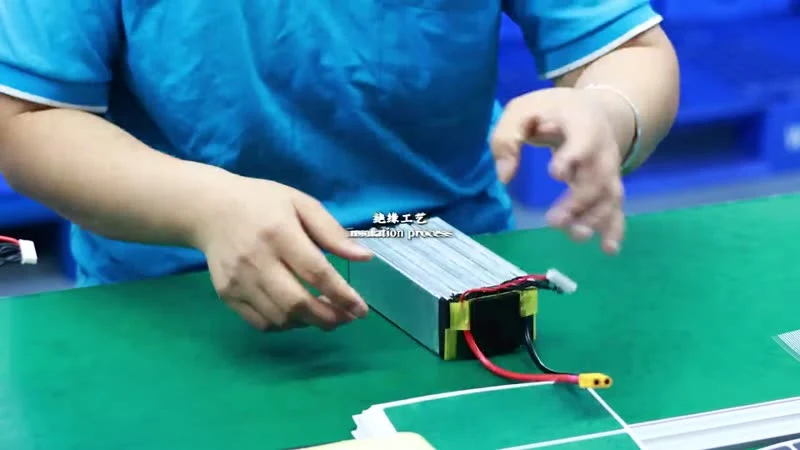
An eight-series pack needs room for its taller cell stack and nine-node balancing harness. Insulation, cable routing and sleeve finishing are considered together to keep the leads accessible without using them as lifting points. Send the tray drawing when specifying a replacement for an existing fleet.

Discuss your aircraft configuration
Share the eight-series power-bus ratings, loaded-flight current and tray drawing with New Journey. Include the charger and adapter models so the power and balancing connections can be specified together.