
Language
12S 22000mAh UAV Battery
The 12S 22000mAh UAV battery uses a 45V nominal configuration with 990Wh of nominal energy. Its 110A continuous and 220A ten-second burst design targets make load matching a central part of selection. The key electrical difference from many familiar 12S packs is its 52.2V charging cut-off voltage.

- 45VNominal voltage
- 990WhNominal energy
- 52.2VCharging cut-off
- 110AContinuous design target
Technical specifications
| Configuration | 12S1P · 22Ah (22000mAh) |
|---|---|
| Nominal voltage | 45V |
| Nominal energy | 990Wh · calculated from nominal voltage × rated capacity |
| Charging cut-off voltage | 52.2V · 4.35V per cell |
| Standard charge current (design) | 11A · 0.5C |
| Continuous discharge design target | 110A · 5C |
| Burst discharge design target | 220A · 10C for 10 seconds |
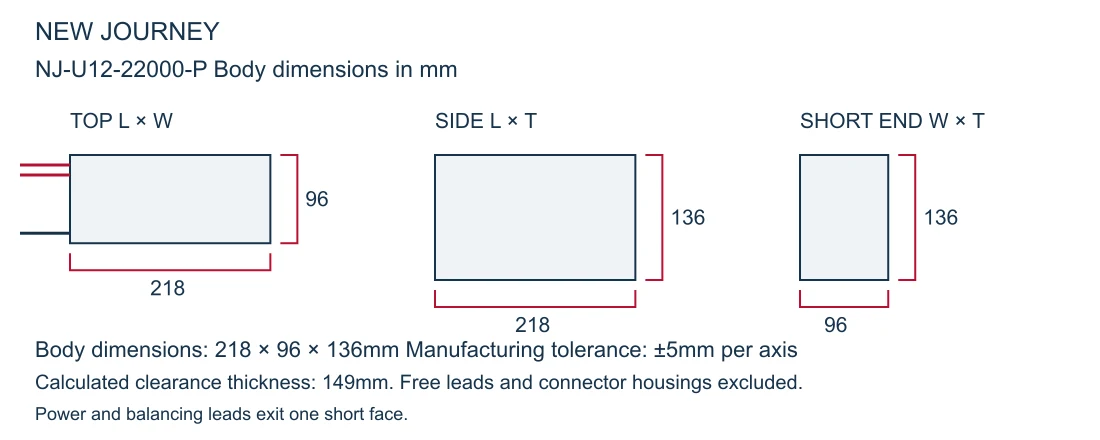
| Body dimensions L × W × T (design) | 218 × 96 × 136mm · ±5mm per axis; free leads and housings excluded |
| Calculated finished-pack weight | 5,180g · production tolerance ±10g from the approved nominal configuration |
| Calculated pack specific energy | 191.1Wh/kg · nominal energy ÷ calculated complete-pack mass |
| Calculated clearance thickness | 149mm · cell growth allowance, separate from initial body tolerance |
| Lead arrangement | About 150mm to connector entry; power and sensing at opposite sides of the same short face |
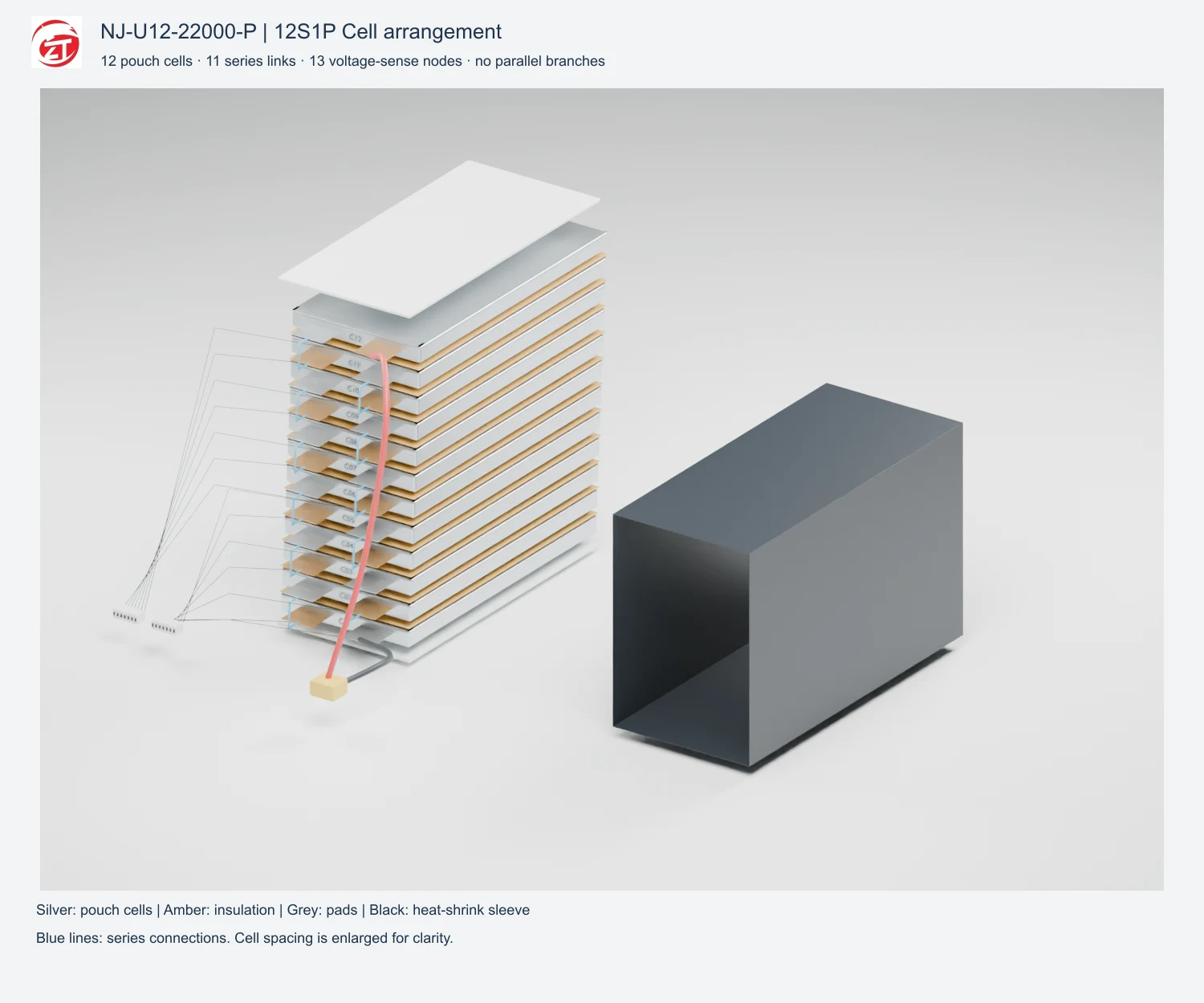
| Balancing interface | Two seven-contact housings · shared B6 · 13 unique nodes |
| Cell model | FAP10790192-22Ah |
| Main connector | Select the complete mating pair, lead specification and polarity for the aircraft |
Check the full-charge voltage before buying a 12S replacement
Two batteries marked 12S can have different upper voltages. This 22Ah configuration reaches 52.2V at full charge; an ESC limited to 50.4V is therefore not an automatic match. Check the power distribution board and accessory converters too. Once the voltage range fits, use the 110A continuous-current design target and 5,180g calculated pack weight to assess the loaded aircraft.
Charging voltage and charger matching
An existing 12S charger must support this battery's 52.2V charging cut-off, not just the series count. Standard charging is designed around 11A. The two seven-contact sensing housings share a midpoint, so check the adapter pinout and charger-channel arrangement before purchase. Two plugs do not make two independent batteries that can be connected to arbitrary charger outputs.
Continuous and burst discharge current
High-current takeoff demand is the main reason to compare this option with the lighter 12S 30Ah pack. Continuous discharge current has a 110A design target, with a 220A burst target for 10 seconds. Describe repeated climbs and recovery peaks as well as the highest reading. New Journey can use that duty profile to specify cable size, joints and the complete connector pair.
Pack weight and aircraft mass budget
Higher current demand and longer flight energy can point to different batteries. This option has a calculated pack weight of 5,180g and 990Wh of nominal energy, giving 191.1Wh/kg at pack level. The 12S 30Ah option has 1,260Wh at 4,108g, but a lower 60A continuous-current design target. Choose against the load and payload requirement together, rather than capacity or weight alone.
Battery dimensions and installation clearance
A tall battery needs secure support and a practical removal path. The body measures 218 × 96 × 136mm, with both lead groups accessible from the short end. Check strap placement and the space beneath the cover before retaining an existing mount. The calculated clearance thickness is 149mm after allowing for cell growth; it is separate from the initial body tolerance.
Series and parallel configuration
The split balancing harness is a key detail when replacing a 12S pack. Twelve 22Ah cells form a 12S1P string with thirteen unique nodes, B0 to B12. Both seven-contact housings share B6. Match that midpoint and polarity on the adapter drawing so the charger sees the intended cell groups rather than an assumed fourteen-node connection.
Frequently asked questions
Is 45V the voltage I should set on the charger?
No. It is the nominal voltage used in the energy calculation. The specified charging cut-off is 52.2V, together with the correct cell programme and current setting.
Why choose 22Ah instead of the lighter 30Ah configuration?
The 22Ah design targets a higher sustained current. The 30Ah option offers more nominal energy at lower reference mass, but does not share the 110A continuous target. The aircraft load decides whether that trade-off is useful.
Can I use the two sensing plugs with a standard adapter?
Only after checking its pinout, shared B6 node and charger-channel arrangement. Housing shape and contact count alone do not establish electrical compatibility.
Battery pack assembly
Twelve-series charging becomes easier to manage when the split balancing harness is clearly mapped and accessible. New Journey can arrange the two sensing housings and power lead around the aircraft mounting position. Cell selection, insulation and electrical checks form separate stages of battery-pack assembly.



Discuss your aircraft configuration
For a 12S 22Ah sample, send New Journey the electronics' maximum input voltages, the load trace and mounting drawing. Include your charger and balancing adapter so the 52.2V charging requirement is covered.