
Language
6S 30000mAh UAV Battery
New Journey's 6S 30000mAh UAV battery configuration provides 630Wh of nominal energy at 21V, with a reference pack weight of 2,094g. It is an option for aircraft projects where energy carried per kilogram matters and the load fits a 60A continuous design target. Charging ends at 25.5V, not at the nominal 21V rating.

- 21VNominal voltage
- 630WhNominal energy
- 25.5VCharging cut-off
- 60AContinuous design target
Technical specifications
| Configuration | 6S1P · 30Ah (30000mAh) |
|---|---|
| Nominal voltage | 21V |
| Nominal energy | 630Wh · calculated from nominal voltage × rated capacity |
| Charging cut-off voltage | 25.5V · 4.25V per cell |
| Standard charge current (design) | 15A · 0.5C |
| Continuous discharge design target | 60A · 2C |
| Burst discharge design target | 90A · 3C for 10 seconds |
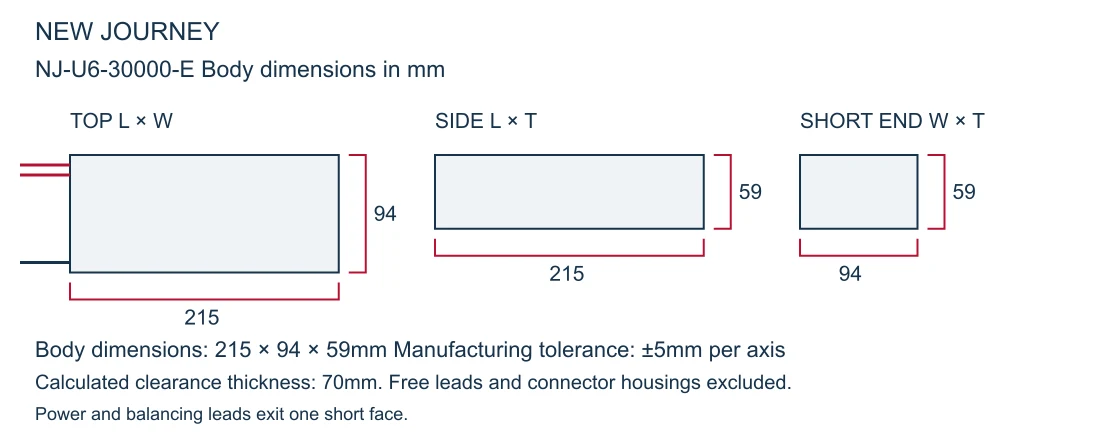
| Body dimensions L × W × T (design) | 215 × 94 × 59mm · ±5mm per axis; free leads and housings excluded |
| Calculated finished-pack weight | 2,094g · production tolerance ±10g from the approved nominal configuration |
| Calculated pack specific energy | 300.9Wh/kg · nominal energy ÷ calculated complete-pack mass |
| Calculated clearance thickness | 70mm · cell growth allowance, separate from initial body tolerance |
| Lead arrangement | About 150mm to connector entry; power and sensing at opposite sides of the same short face |
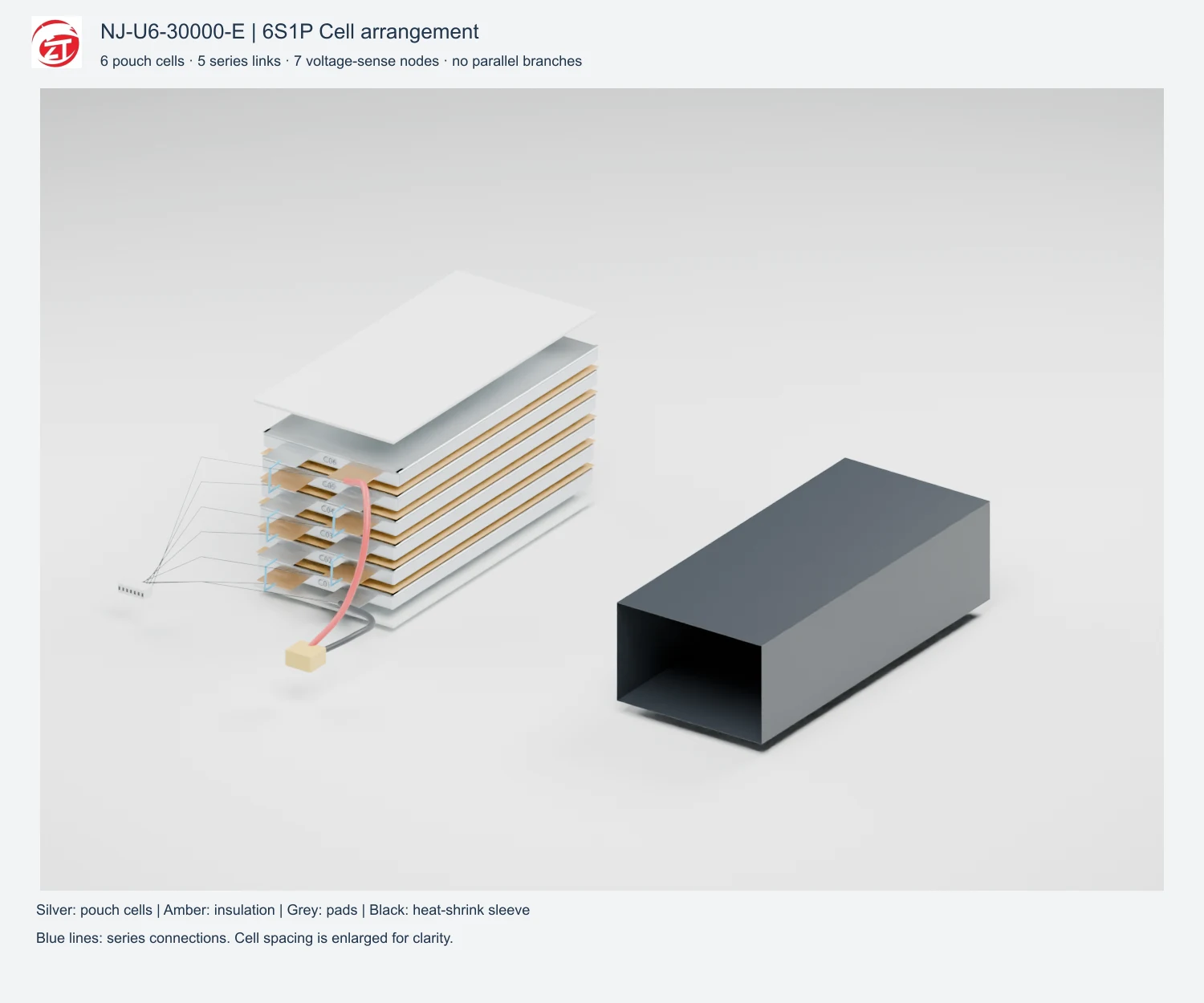
| Balancing interface | Seven contacts · B0 to B6 |
| Cell model | EDP8887188-30Ah |
| Main connector | Select the complete mating pair, lead specification and polarity for the aircraft |
Carry more energy without using up the payload allowance
A larger battery can reduce the payload left for a camera, sensor or other equipment. This 6S 30Ah option combines 630Wh nominal energy with a calculated pack weight of 2,094g, compared with 495Wh and 2,670g for the 6S 22Ah option. Its 60A continuous-current design target is lower. For mapping and inspection, check loaded climb current before choosing the lighter, higher-energy option.
Charging voltage and charger matching
Replacing a 6S battery does not always mean keeping the same charger programme. This configuration uses a 25.5V charging cut-off and a 15A standard-charge design setting. A fixed 25.2V programme has a different endpoint. Check the cell profile, available current and six-group balancing before committing to a charging station for the fleet; the 21V nominal rating is not the charging voltage.
Continuous and burst discharge current
Low cruise current can hide a higher demand during takeoff, acceleration or recovery. Continuous discharge current is targeted at 60A, with 90A for a 10-second burst. Compare those limits with a loaded mission trace, including repeated peaks. If the aircraft needs more sustained current, compare the 22Ah configuration before assuming that the larger 30Ah capacity is the better fit.
Pack weight and aircraft mass budget
Use the battery-pack figure when calculating payload. The 2,094g calculated pack weight includes 1,950g of cells and 144g of assembly allowance for wiring, insulation and other materials. Nominal energy divided by that mass gives 300.9Wh/kg. Cell energy density and pack specific energy describe different assemblies; add the aircraft tray and restraints separately when calculating takeoff weight.
Battery dimensions and installation clearance
The thinner 59mm body can help in a shallow battery compartment, provided the pack is properly supported. Its footprint is 215 × 94mm, and approximately 150mm of lead runs from the body exit to connector entry. Check strap contact, cable bends and access to unplug the battery. Use the separate 70mm calculated clearance thickness when assessing space for cell growth.
Series and parallel configuration
A replacement harness must connect to the correct cell nodes. Six 30Ah pouch cells form a 6S1P pack, retaining 30Ah capacity across seven sensing nodes, B0 to B6. Confirm the seven-contact pinout and polarity with the charger adapter before ordering. New Journey can specify the main connector and lead direction around the aircraft layout.
Frequently asked questions
Why is this 6S battery rated at 21V rather than 22.2V?
Its cell is specified at 3.5V nominal. Six in series give 21V. Series count does not impose the nominal voltage of a different cell design.
Will the larger capacity handle a higher takeoff current?
Capacity and current capability are separate. This configuration targets 60A continuously and 90A for 10 seconds, so compare the aircraft's takeoff trace against those figures even if its cruise demand is low.
Can it use the same tray as the 6S 22Ah option?
The reference footprints differ: 215 × 94mm here and 218 × 96mm for the 22Ah design. Check the actual tray, restraint contact and cable access; do not assume that a smaller body is correctly supported.
Battery pack assembly
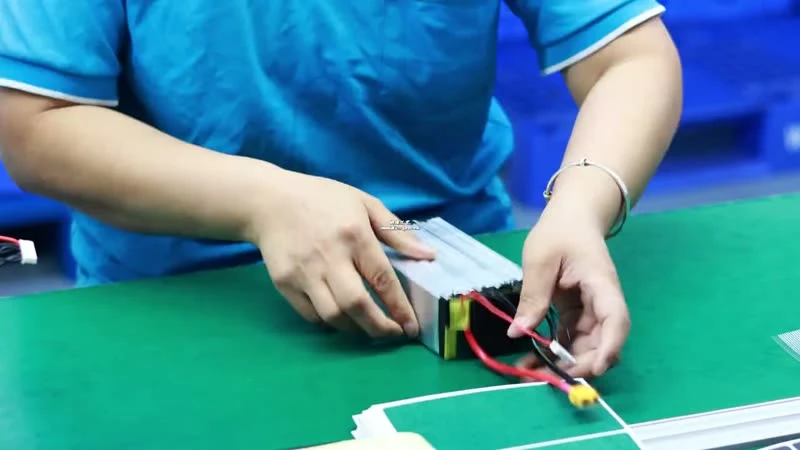
A shallow battery bay leaves little room for poorly positioned leads. New Journey can adapt the short-end cable exits, insulation and sleeve finish to the available space. Support under the pouch-cell stack and accessible connector positions help the operator secure and remove the pack without pulling its wires.

Discuss your aircraft configuration
Send New Journey your loaded climb current, target payload, battery-bay drawing and charger details. These inputs help select the 6S 30Ah pack layout and cable arrangement for your sample.