
Language
8S 39000mAh UAV Battery
This 8S 39000mAh UAV battery offers 1,123.2Wh of nominal energy at 28.8V. Its 3,652g reference mass and 95mm body thickness make mounting space and aircraft weight as important as capacity. The continuous-current design target is 117A, with a 195A ten-second burst target and a 33.6V charging cut-off.
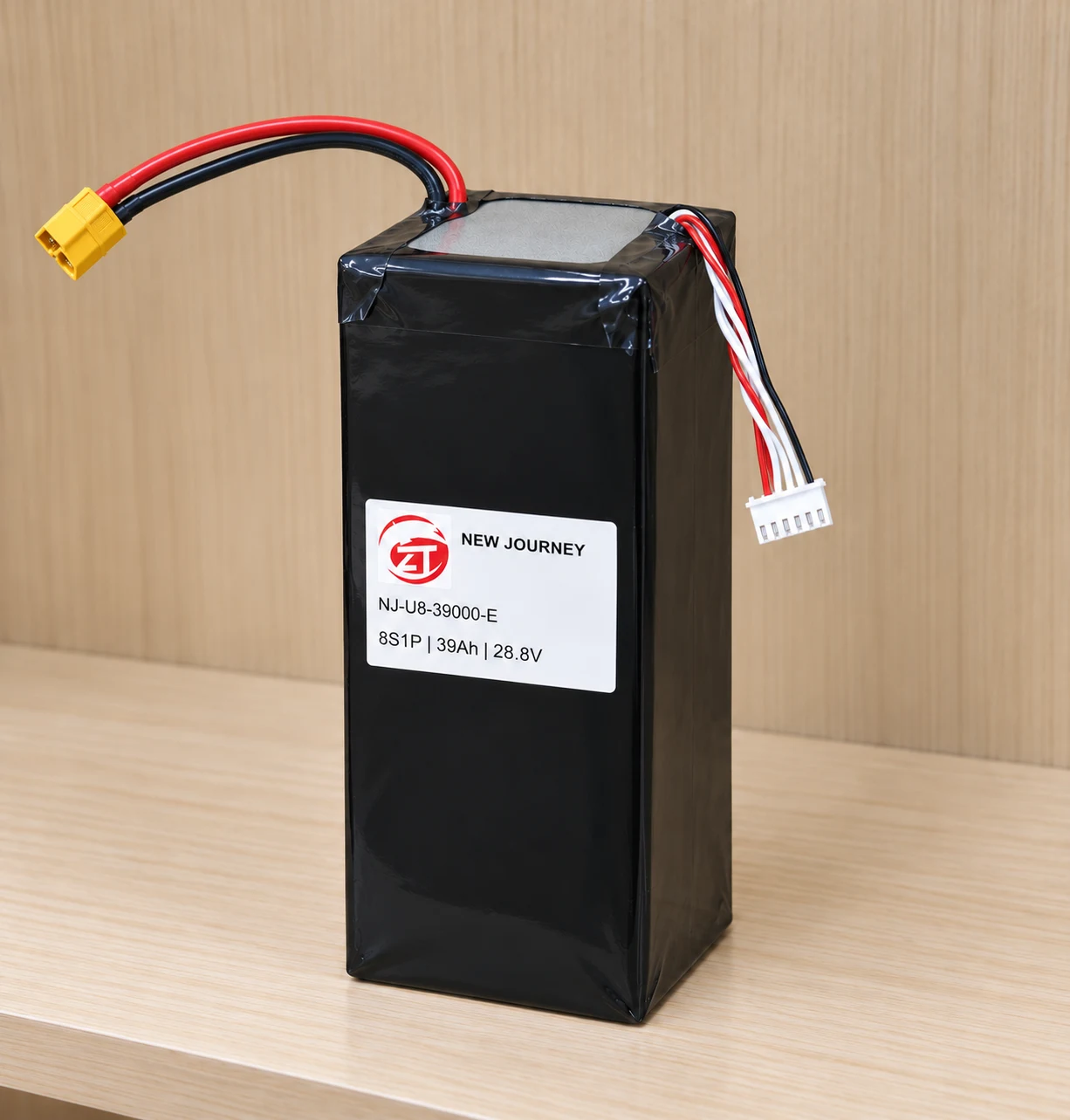
- 28.8VNominal voltage
- 1123.2WhNominal energy
- 33.6VCharging cut-off
- 117AContinuous design target
Technical specifications
| Configuration | 8S1P · 39Ah (39000mAh) |
|---|---|
| Nominal voltage | 28.8V |
| Nominal energy | 1123.2Wh · calculated from nominal voltage × rated capacity |
| Charging cut-off voltage | 33.6V · 4.2V per cell |
| Standard charge current (design) | 19.5A · 0.5C |
| Continuous discharge design target | 117A · 3C |
| Burst discharge design target | 195A · 5C for 10 seconds |
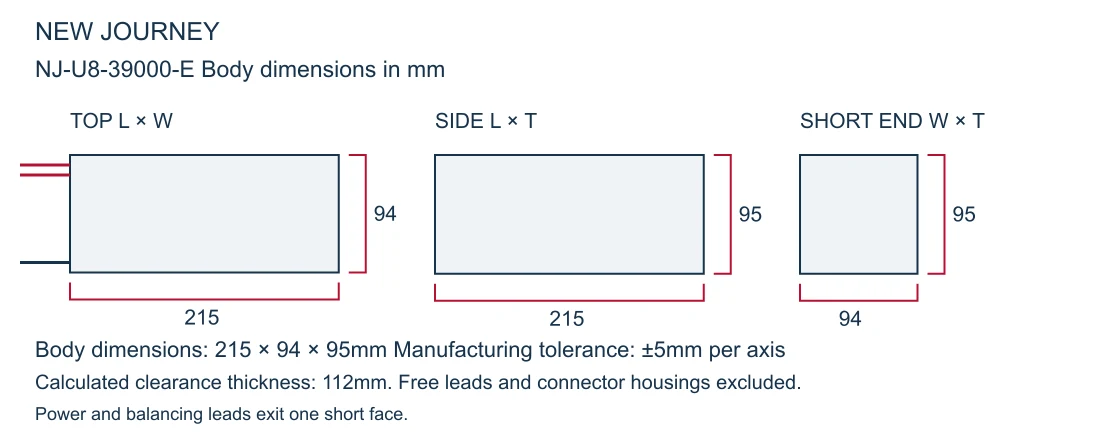
| Body dimensions L × W × T (design) | 215 × 94 × 95mm · ±5mm per axis; free leads and housings excluded |
| Calculated finished-pack weight | 3,652g · production tolerance ±10g from the approved nominal configuration |
| Calculated pack specific energy | 307.6Wh/kg · nominal energy ÷ calculated complete-pack mass |
| Calculated clearance thickness | 112mm · cell growth allowance, separate from initial body tolerance |
| Lead arrangement | About 150mm to connector entry; power and sensing at opposite sides of the same short face |
| Balancing interface | Nine contacts · B0 to B8 |
| Cell model | ECP11087188-39Ah |
| Main connector | Select the complete mating pair, lead specification and polarity for the aircraft |
When the 30Ah option leaves too little route or climb margin
If the 8S 30Ah pack is short on both route energy and loaded-climb current, compare this 39Ah configuration. It adds 283.2Wh and raises the continuous-current design target from 60A to 117A. The cost is 900g more calculated pack weight and 18mm more body thickness. Check the heavier aircraft's load and balance before treating the change as a direct upgrade.
Charging voltage and charger matching
Do not carry over the 8S 30Ah charger settings unchanged. This version has a 33.6V charging cut-off rather than 34V, and a 19.5A standard-charge design setting rather than 15A. Match the cell profile and nine-node balancing arrangement as well. Include both battery versions in the charging-station plan if the fleet will use a mixed configuration.
Continuous and burst discharge current
A peak-current figure needs a duration to be useful in procurement. This pack targets 117A continuous discharge current and 195A for a 10-second burst. Describe consecutive climbs and recovery events so their repeat interval is covered. The main plug, conductors and terminations must be specified for the same duty as the battery, not selected by housing shape alone.
Pack weight and aircraft mass budget
The 3,652g calculated pack weight includes 3,440g of cells and 212g of assembly allowance. Calculated pack specific energy is 307.6Wh/kg at 1,123.2Wh nominal energy. Check the payload and centre-of-gravity limits with this complete-pack mass installed. Add the support tray separately, and include connector or cable changes before agreeing the nominal battery weight.
Battery dimensions and installation clearance
A deeper pack may fit the tray footprint but interfere with the cover or straps. This body is 215 × 94 × 95mm. Check access around both short-end lead groups and the path for unplugging and lifting the battery. Approximately 150mm of lead is measured along each cable to connector entry; the separate calculated clearance thickness is 112mm.
Series and parallel configuration
An 8S1P configuration contains eight 39Ah cells and nine sensing nodes, B0 to B8. Match those nodes to the balancing adapter before choosing a replacement harness. The main power lead and sensing wires serve different currents and functions. Include any aircraft communication or protection requirement explicitly so the ordered interface covers the actual system.

Frequently asked questions
Can I keep the charge settings used for the 8S 30Ah version?
Not without checking them. The 30Ah configuration uses a 34V charging endpoint, while this one uses 33.6V. Their proposed standard charge currents also differ.
How should I compare 8S 39Ah with 12S 30Ah?
Start with the aircraft voltage architecture. They use different nominal and charging voltages, so energy or weight alone does not make them interchangeable. Then compare load duty and installation space within a compatible power system.
Can the sensing lead be used as the main charging cable?
It is intended for cell-group sensing and balancing. The high-current charge path and any protection electronics must be defined in the agreed circuit and connector drawing.
Battery pack assembly
The deeper 39Ah stack changes the space available for straps, insulation and cable bends. New Journey can work from the battery-bay drawing to position the leads and connectors for routine removal. Cell selection, insulation and electrical checks support a repeatable assembly process.


Discuss your aircraft configuration
Share the loaded climb trace, planned route, available mounting depth and charger settings with New Journey. We can help compare the 8S 30Ah and 39Ah layouts against your payload and connection requirements.