
Language
12S 30000mAh UAV Battery
This 12S 30000mAh UAV battery configuration offers 1,260Wh of nominal energy at 42V and a reference pack weight of 4,108g. It is intended for twelve-series aircraft projects whose load fits the 60A continuous design target. Its charging cut-off voltage is 51V; the 42V nominal label must not be used to select a charger.
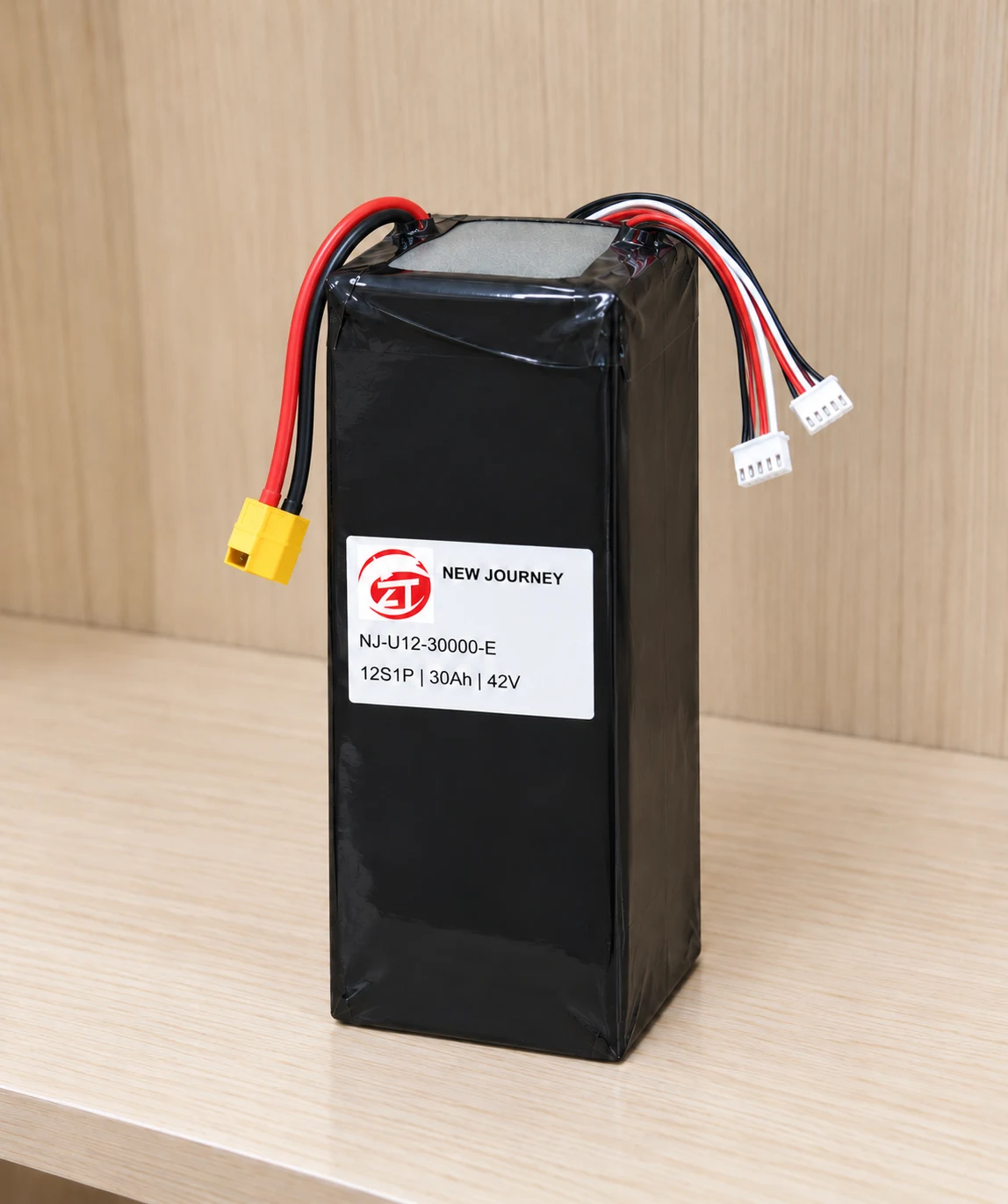
- 42VNominal voltage
- 1260WhNominal energy
- 51VCharging cut-off
- 60AContinuous design target
Technical specifications
| Configuration | 12S1P · 30Ah (30000mAh) |
|---|---|
| Nominal voltage | 42V |
| Nominal energy | 1260Wh · calculated from nominal voltage × rated capacity |
| Charging cut-off voltage | 51V · 4.25V per cell |
| Standard charge current (design) | 15A · 0.5C |
| Continuous discharge design target | 60A · 2C |
| Burst discharge design target | 90A · 3C for 10 seconds |
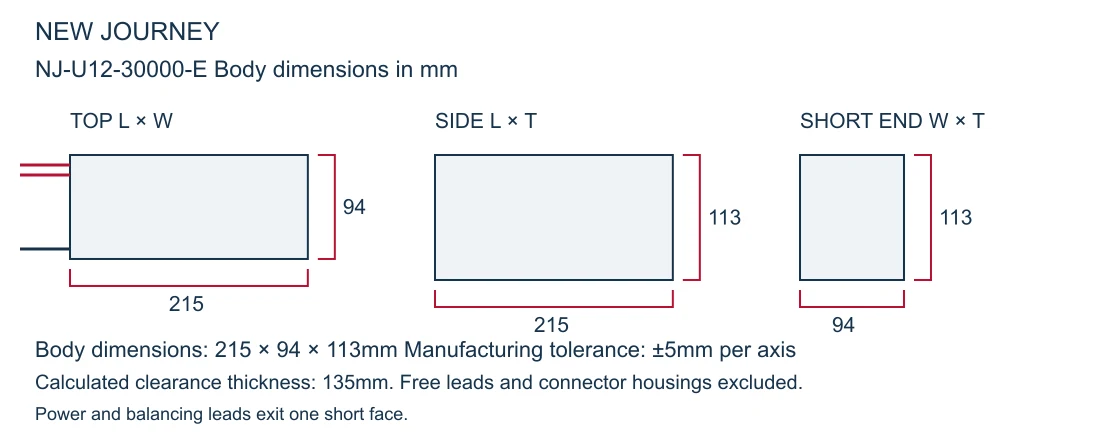
| Body dimensions L × W × T (design) | 215 × 94 × 113mm · ±5mm per axis; free leads and housings excluded |
| Calculated finished-pack weight | 4,108g · production tolerance ±10g from the approved nominal configuration |
| Calculated pack specific energy | 306.7Wh/kg · nominal energy ÷ calculated complete-pack mass |
| Calculated clearance thickness | 135mm · cell growth allowance, separate from initial body tolerance |
| Lead arrangement | About 150mm to connector entry; power and sensing at opposite sides of the same short face |
| Balancing interface | Two seven-contact housings · shared B6 · 13 unique nodes |
| Cell model | EDP8887188-30Ah |
| Main connector | Select the complete mating pair, lead specification and polarity for the aircraft |
Reduce battery mass and mounting depth on a 12S aircraft
If the battery is consuming payload or cover clearance, compare the 30Ah and 39Ah versions together. This 12S 30Ah configuration saves 1,300g of calculated pack weight and 27mm of body thickness, while carrying 1,260Wh rather than 1,684.8Wh. Its continuous-current design target is also lower: 60A instead of 117A. Check the loaded climb demand before choosing the lighter pack.
Charging voltage and charger matching
A 42V nominal battery label is not a charger setting. This configuration requires a 51V charging cut-off and a 15A standard-charge design setting. Confirm that the charging station supports the cell profile and all twelve balancing groups. The split sensing harness shares a midpoint, so include the adapter and channel-isolation details when retaining existing equipment.
Continuous and burst discharge current
Saving weight is useful only if the battery covers the loaded mission. Continuous discharge current is targeted at 60A, with a 90A burst target for 10 seconds. Check takeoff, climb and recovery duration before relying on a lower cruise-current figure. A repeated mission trace gives New Journey the information needed to specify the main connector, conductors and cable layout.
Pack weight and aircraft mass budget
Calculated pack weight is 4,108g, including the specified leads and connectors. The cells account for 3,900g, leaving 208g of assembly allowance. At 1,260Wh, calculated pack specific energy is 306.7Wh/kg. Compare this complete-pack mass with the payload limit and mounting hardware included; the higher cell energy-density figure should not be used as the finished battery weight.
Battery dimensions and installation clearance
The 215 × 94 × 113mm body is shallower than the 39Ah version, which can ease cover clearance and handling. Still check strap position, body support and access to both cable groups. Allow room to remove the pack without pulling on its leads. The separate calculated clearance thickness is 135mm after accounting for cell growth.
Series and parallel configuration
Two balancing plugs need a specific wiring map. The 12S1P pack contains twelve 30Ah cells and thirteen unique nodes, B0 to B12. Its two seven-contact sensing housings share B6. Confirm that common node and the charger's channel arrangement with the adapter specification; two housings do not imply two independent charging circuits.

Frequently asked questions
Why is nominal voltage 42V if charging ends at 51V?
42V is the nominal battery voltage used to calculate 1,260Wh. 51V is the upper charging endpoint. They describe different parts of the specification and are not interchangeable.
Would 39Ah be the safer choice for every long mission?
The 39Ah design brings more energy and a higher current target, but also more mass and a deeper body. Compare route energy, climb demand, payload allowance and installation space before selecting it.
Does the heat-shrink exterior provide a waterproof enclosure?
The specified exterior is a wrapped pouch-cell assembly. If exposure to rain, spray or dust requires an ingress-protection rating, define the enclosure and its rating separately rather than inferring it from the sleeve.
Battery pack assembly
The two balancing housings need a clear shared-midpoint arrangement and a practical route to the charger adapter. New Journey can align the harness position, insulation and sleeve finish with the aircraft mount. This helps avoid a pack that fits the tray but is awkward to connect during a battery change.



Discuss your aircraft configuration
For this 12S 30Ah option, send New Journey the loaded current, payload limit, mounting depth and charger model. Include the existing adapter drawing if the charging station must stay in service.